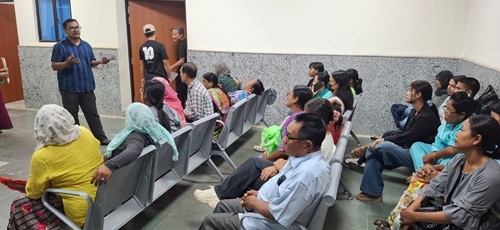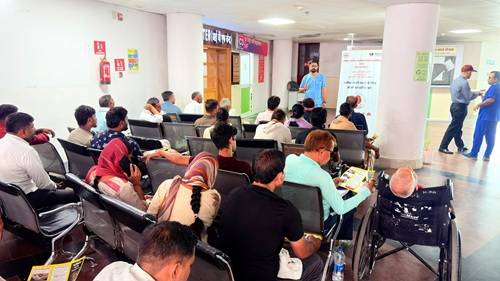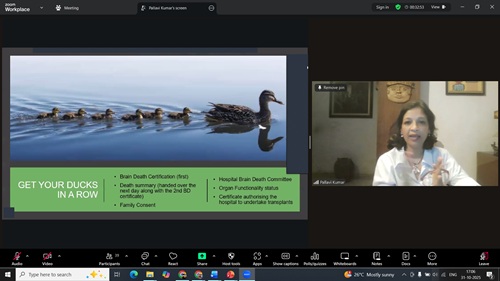
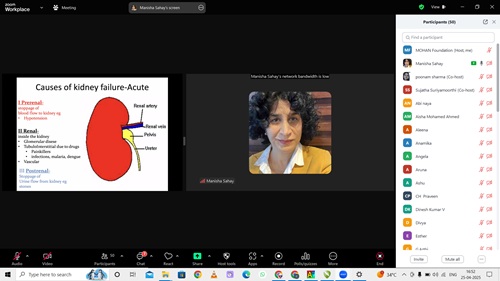
The one-year online Post Graduate Diploma in Transplant Coordination and Grief Counselling (PGDTC) batch of 2025 successfully completed their course in December 2025. This, yearlong course provided the participants with the knowledge and skills required to negotiate the complexity of transplant coordination and grief counselling.
Course Structure and Delivery: The key elements of the course included access to the e-learning platform with study materials and resources, online assignments and assessments to reinforce learning, and bi-monthly interactive webinars featuring professionals in organ donation and transplantation. These online webinars concentrated on several important subjects, majorly classified under major headings:
Basic Concepts of Organ Donation and Transplantation
The session included essential information on living and deceased organ donation, including related and unrelated donors. It also included information on types of deceased donations such as Donation after Circulatory Death (DCD) and Donation after Brainstem Death (DBD). The participants were also introduced to various transplant techniques such as split liver transplantation, swap liver transplantation, and domino transplantation. Information on the process of consent, including India’s opt-in system, the significance of donor cards, and the significance of family discussions regarding deceased organ donation was also provided.
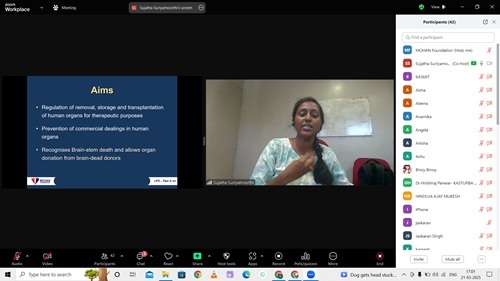
Legal and Ethical Aspects of Organ Donation and Transplantation
The sessions gave participants a clear and practical understanding of the rules that guide organ donation and transplantation in India. It explained the legal framework outlined for declaring brainstem death, approvals obtained for related and unrelated living donors, and registering hospitals as transplant centres / retrieval centres. The discussion also covered the step-by-step procedures and documentation involved in deceased and living donations.
The components of medical ethics-beneficence, non-maleficence, transference, justice, confidentiality, and autonomy, were discussed with the participants. Case studies were shared as part of the session, and participants were encouraged to apply these ethical principles and share their perspectives on each scenario.
Medical Aspects of Organ Donation and Transplantation
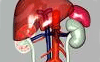
Several contact sessions were conducted under this section, focusing on the functions of different organs, common diseases, organ failure, and available treatment options including transplantation. The sessions also covered important aspects of tissue donation, methods of preservation, the role of tissue banks.
Topics covered under the medical aspects were:
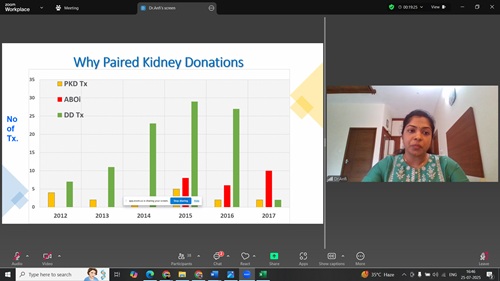
Transplant Coordination
The role of the transplant coordinator in deceased and living donor transplantation was explored in depth. The sessions focused on building knowledge and understanding in key areas related to coordination, communication, and the management of processes involved in both deceased and living donor transplantation.
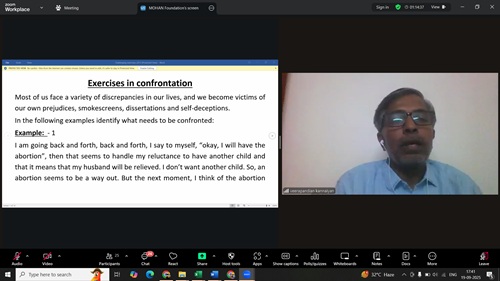
Counselling and Approaching families for organ donation
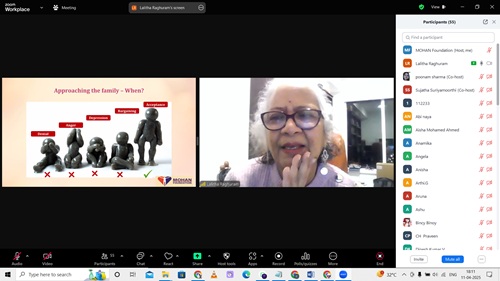
The session emphasized on role of care, sensitivity, and compassion during organ donation counselling, which needs to happen within brief time limits but requires professionals to understand how the family experiences grief. The session included a detailed introduction to the stages of grief based on the Kubler-Ross model and how no two families undergo the same journey of grief.
Other topics covered under this heading were:
Experts across the country were on the faculty board. The webinars comprised several activities including quizzes, case study discussions, and interactive sessions to guarantee active participation and engagement. These exercises gave participants the chance to apply theoretical knowledge to real-world situations, thus, promoting a better awareness and skill development.
The course structure included online assignment submissions. The online examination was conducted on 13th December, 2025. Successful candidates (who had scored 60% marks) were awarded their course completion certificates.
Feedback
Ms. Shyama Albert, Lourdes Hospital, Kochi
Enrolling in the Post Graduate Diploma in Transplant Coordination course by MOHAN Foundation has been one of the most enriching professional decisions of my career. This has significantly deepened my conceptual clarity and strengthened my practical competencies in the field of transplantation. I strongly recommend this course to all healthcare workers who wish to contribute meaningfully to the transplant program
Mrs. Kavitha B, Command Hospital Airforce, Bangalore
I deeply express my gratitude to the entire course coordination team of MOHAN foundation. Also, I am grateful to the support and guidance provided. I would like to express my humble suggestion 1. The time duration for the part 1 exam can be reduced and the part 2 can be increased. 2. After evaluating the Assignments, a model answer can be given so that the candidate can rectify the drawbacks.
Mrs. Hilda Ngulube, National Heart Hospital, Zambia
For the international students especially countries like us from Zambia who are just starting the transplant program, it will be helpful to incorporate a few weeks physical practical experience. To come and have an onsite learning from the team, the theory we have learned has greatly improved our knowledge, but only if it can be coupled with physical onsite training just few weeks.





























-ACT,-2011.gif)